
1941 West Fort St

Detroit, MI 48216

313-496-0550

Mon - Fri 8:45 a - 4 p ET

Porter Bottle Company

Who Are the Top 10 Fishing Tackle Suppliers in China?

Finding dependable fishing tackle suppliers in China takes more than comparing prices. This guide introduces ten suppliers and explains what buyers can examine before requesting a quotation. The focus is practical: product range, manufacturing capabilities, sample availability, quality checks, minimum order quantities, packaging, and communication.

Look closely at the details. A fishing reel may appear well finished in a catalogue, yet its handle, drag adjustment, and component fit deserve hands-on inspection. For FISHING TACKLES such as rods, lines, hooks, and lures, product specifications should be clear and consistent. Ask for samples, confirm materials and dimensions, and check whether production standards match your needs. These steps do not guarantee a perfect order. They can, however, reveal gaps before a large commitment.

Supplier claims also need context. Factory ownership, export experience, certifications, and delivery estimates should be verified directly, with documents where appropriate. The “top ten” is a useful starting point, not a universal ranking; the right partner depends on your product category, budget, order size, and service expectations. Some details are easy to miss. Response time, for example, may matter as much as a low unit price when specifications change. This comparison aims to make those trade-offs visible, while recognizing that supplier information can change and should be checked before purchase. A little uncertainty remains. That is worth admitting.
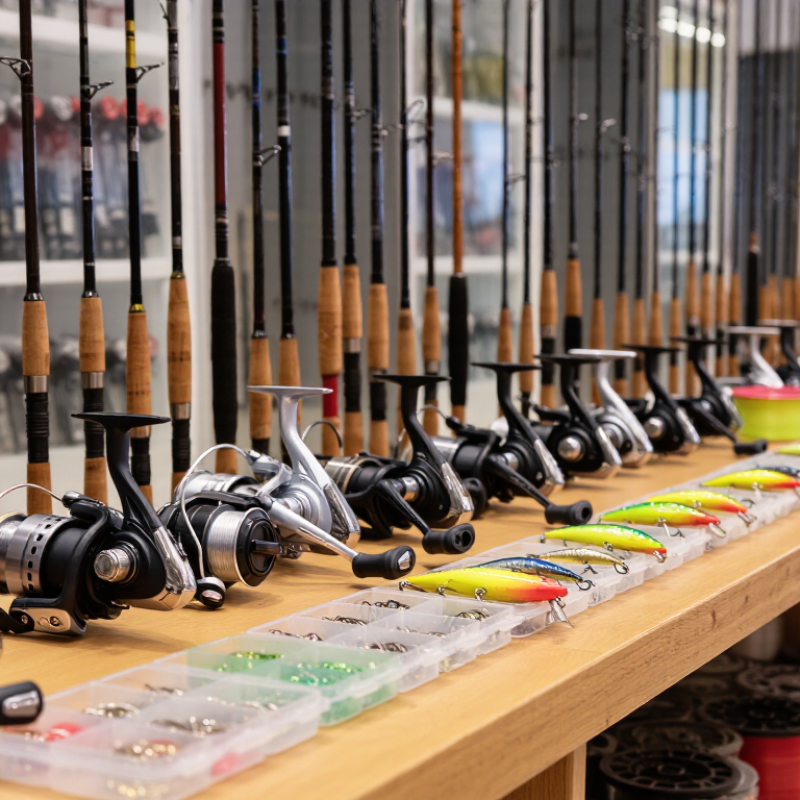
Who Are the Top 10 Fishing Tackle Suppliers in China?

How China’s Fishing Tackle Supply Industry Is Organized

China’s fishing tackle supply industry is organized as a network, not a single factory line. One supplier may mold plastic floats, while another makes hooks, reels, rods, or fabric bags. These workshops often rely on nearby makers for metal parts, packaging, and finishing. The chain is layered. A finished product may pass through several hands before export.

Some companies focus on manufacturing, while others coordinate design, sourcing, inspection, and shipping. Larger suppliers may offer OEM or ODM services; smaller specialists can be more flexible with components or short production runs. Buyers should check who actually makes each part. Ask for material specifications, sample approval, and clear inspection criteria. Details matter. A polished sample does not always represent every production batch, and I would not assume that one supplier controls the whole process. That picture is useful, but imperfect.

Tips: Request a component list and confirm production responsibilities in writing. Compare samples under real use, not just on a desk. Check finish, line guides, reel movement, and packaging. Leave time for revisions; they are easy to underestimate.

China’s fishing tackle supply chain typically spans component and materials sourcing, specialized manufacturing, assembly, quality control, and export or domestic distribution. The bars show an illustrative complexity index, not supplier counts, market shares, or measured industry statistics.

Criteria for Identifying the Top 10 Suppliers

A credible supplier shortlist starts with evidence, not a polished catalog. Check whether the factory can produce the specific rods, reels, lines, or accessories you need. Ask for production photos, sample specifications, and details about material sourcing. Numbers matter. A sample can reveal uneven coating, rough thread finishes, or a reel handle that feels loose under light pressure. Compare samples from several suppliers using the same checks.

Quality control should be documented and repeatable. Ask how incoming materials, in-process parts, and finished goods are inspected. Request recent test records where relevant, and confirm that product specifications match the sample. Ask for proof. Also compare minimum order quantities, production lead times, packaging options, and responses to defect reports. Clear answers are useful; vague promises are not. Export experience may help with paperwork and shipping coordination, but verify references and documents rather than relying on claims alone. Communication deserves a practical test: send a detailed inquiry and note whether the reply addresses each point. No supplier is perfect, and the cheapest quote may bring slower updates or less consistent finishing. A small trial order can expose gaps before a larger commitment.

Profiles of 10 Leading Chinese Fishing Tackle Suppliers

China’s fishing-tackle suppliers cover different parts of the market. One workshop may specialize in rods, while another assembles reels. Other common profiles include fishing-line makers, hook producers, lure molders, net manufacturers, tackle-box factories, float specialists, combo-kit exporters, and sourcing firms coordinating several product types. Their strengths differ. A small factory might offer flexible colors but limited production capacity. A larger operation may handle volume yet provide less design attention. Catalog photos do not always show how consistently products are made.

When assessing a supplier, ask for material specifications, sample lead times, packaging details, and inspection procedures. For rods, check joint fit and guide alignment; for boxes, examine hinges and latch strength. Request recent production photos, but treat them as supporting evidence, not proof. I would also confirm which processes happen in-house. That detail can be easy to overlook, and it may affect delivery schedules. Compare samples under ordinary use, not just on a clean display table.

Tips: Start with a small sample order. Record defects, measurements, and response times. Clear questions often reveal more than a polished catalog.

Comparing Product Ranges and Manufacturing Capabilities

Comparing China’s fishing-tackle suppliers means looking beyond catalog size. Some factories focus on soft baits and molded components; others produce rods, reels, lines, hooks, or complete assortments. FAO’s 2024 SOFIA report puts global fisheries and aquaculture production at 223.2 million tonnes in 2022. That figure describes the wider sector, not tackle demand, but it shows why dependable equipment supply matters. For buyers, check whether a supplier controls tooling, material selection, assembly, and inspection—or outsources key steps. Ask for sample specifications, test records, and realistic production capacity. A polished catalog alone proves little.

Product range is only half the comparison. A rod maker may offer carbon-fiber blanks and handle assembly, while a bait producer may have in-house molds, color matching, and packaging. Request close-up photos of mold lines, reel drag tests, and line diameter checks. Also compare minimum order quantities, sample lead times, and how defects are handled. These details reveal more than a broad “one-stop” claim. Even experienced buyers can miss this: capacity listed on paper may not reflect busy-season output.

Tips: Send the same specification sheet to each supplier. Compare materials, tolerances, test methods, and delivery dates side by side. Then verify one production sample before scaling an order.

Who Are the Top 10 Fishing Tackle Suppliers in China? - Comparing Product Ranges and Manufacturing Capabilities

Category-level comparison of common fishing-tackle manufacturing specialties. These are product categories, not ranked or verified individual suppliers; capabilities vary by factory and should be confirmed directly.

No. Supplier Specialty Typical Product Range Common Manufacturing Capabilities Useful Evaluation Points
1 Fishing rods Spinning, casting, surf, fly, and telescopic rods Blank rolling on mandrels, curing, trimming, guide installation, handle assembly, and finishing Ask about blank materials, power and action consistency, guide alignment, and load testing.
2 Fishing reels Spinning, baitcasting, conventional, and fly reels Component machining or casting, gear and drag assembly, surface finishing, and function testing Check gear materials, drag smoothness, corrosion protection, and inspection procedures.
3 Fishing line Monofilament, fluorocarbon, and braided line Polymer extrusion for monofilament, fiber braiding for braided line, and winding and spooling Verify stated diameter, breaking-strength test methods, knot performance, and spool-length controls.
4 Hooks Single, treble, circle, jig, and specialty hooks Wire forming, point grinding, heat treatment, coating, and dimensional inspection Review point sharpness, hook-wire consistency, corrosion resistance, and batch traceability.
5 Artificial lures Hard baits, soft plastics, metal lures, and spinnerbaits Plastic injection molding, metal stamping or forming, painting, finishing, and component assembly Request checks for weight, finish adhesion, swimming action, and consistency between samples and production.
6 Terminal tackle Swivels, snaps, sinkers, split rings, and rigs Wire forming, stamping, casting, plating or coating, and small-part assembly Confirm dimensions, load ratings where applicable, finish quality, and material specifications.
7 Fishing nets Landing nets, bait nets, keep nets, and netting panels Netting or mesh fabrication, frame forming, handle assembly, and seam reinforcement Check mesh size, frame strength, handle joints, and material suitability for the intended use.
8 Tackle bags and storage Tackle bags, rod cases, lure boxes, and utility pouches Fabric cutting and sewing, compartment construction, plastic-box molding, and zipper installation Evaluate stitching, zipper durability, compartment dimensions, and water-resistance claims.
9 Fishing apparel Fishing shirts, gloves, hats, waders, and protective clothing Pattern cutting, garment sewing, seam sealing for applicable products, and finishing Request fabric specifications and, where relevant, test evidence for waterproof or UV-protection claims.
10 Fishing accessories Rod holders, pliers, scales, tool kits, and mounting accessories Metal machining or forming, plastic molding, assembly, and functional inspection Confirm material grades, moving-part function, finish durability, and packaging requirements.

Note: This overview describes common product types and processes only; it does not identify, rank, or certify any specific supplier. Verify factory ownership of production equipment, quality-control records, product samples, and applicable compliance documents before placing an order.

How Buyers Can Evaluate and Select a Supplier

Choosing among Chinese fishing tackle suppliers takes more than comparing unit prices. Ask for current product specifications, material details, and clear measurements for each item. Request samples that match the production version you may order. Check surface finish, moving parts, stitching, and packaging under ordinary use. Small defects matter. A reel that feels smooth once may loosen after repeated turns, so test several pieces instead of relying on one sample. Keep notes and photos to make discussions about changes more precise.

Ask about typical lead times, order quantities, and how finished goods are inspected. Request inspection records or a written explanation of the supplier’s quality checks. Compare quotes only after confirming what each price includes, such as packaging, sample charges, and shipping terms. Clarify acceptable tolerances and how defects are handled. A fast reply helps, but it does not prove consistent production. Consider a small trial order before committing to a larger quantity. It may cost more per unit, and that trade-off deserves honest attention.

Article Source:

Scroll to Top