How to Choose Glass Jars for Your Business?
Choosing glass jars for your business affects more than how a product looks on a shelf. The right jar can protect product quality, support smooth filling, and make storage easier. The wrong one may create avoidable costs, even when its price seems attractive. A few millimeters can matter. A jar that fits a label poorly or feels awkward in the hand may weaken an otherwise polished presentation.
Start by matching the jar’s material, capacity, and opening to the product and its use. Consider whether customers need a wide mouth, whether the contents require added protection from light, and how the jar will travel through filling, shipping, and retail display. Then compare closure compatibility, glass thickness, weight, and supplier consistency. Ask for product specifications and samples, rather than relying on a catalog image. Test the jar with your actual product, label, and closure. Small details show.
Cost deserves careful review, but the lowest unit price rarely tells the whole story. Freight, breakage, storage space, and packing speed can change the calculation. A checklist helps, though it cannot predict every handling issue; a real-world trial may reveal what the sample inspection missed. It is worth reconsidering assumptions as order volumes grow. A flexible choice today may not suit tomorrow’s production line. This guide explores practical criteria for comparing glass jars, asking suppliers informed questions, and choosing packaging that fits both your product and your business operations.
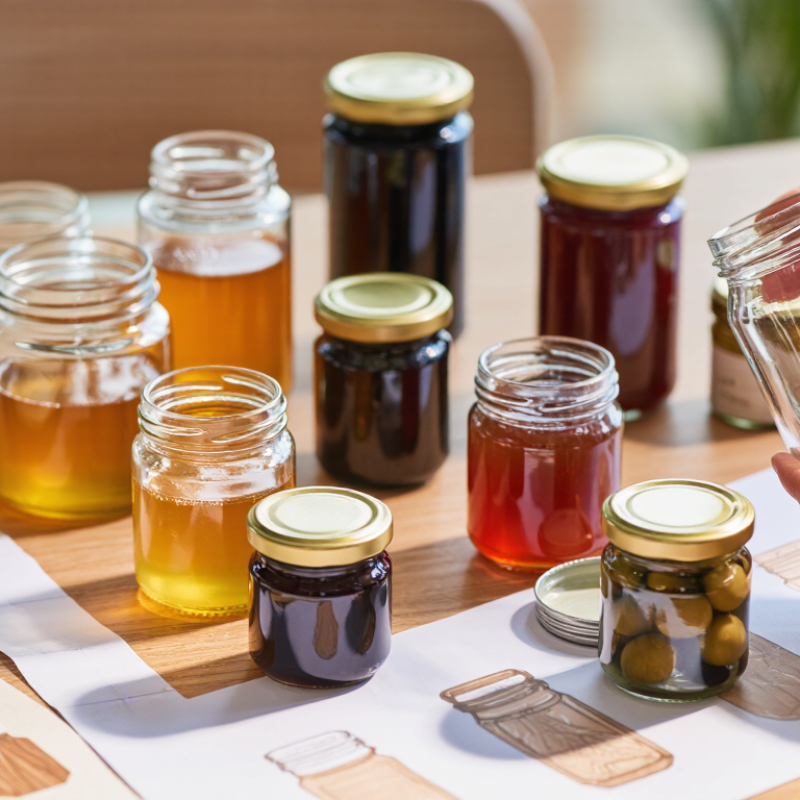
Define Product Needs: Soda-Lime Glass Accounts for About 90% of Glass Production
When choosing glass jars, start with what they must contain, not how they look. Soda-lime glass accounts for about 90% of glass production worldwide, making it the most common choice for packaging. Made mainly from silica, soda ash, and limestone, it suits efficient, high-volume manufacturing. For a business, that can mean broad availability and predictable sourcing. A popular material is not automatically the right fit.
Check the product’s acidity, oils, filling temperature, and storage conditions. These details affect whether the jar and its closure perform as expected. Hot filling, for example, can create thermal stress if the glass design is unsuitable.
Ask suppliers for specifications on capacity, wall thickness, and temperature limits. Then test filled jars under realistic handling and storage conditions.
Small details matter. A jar that looks sturdy on a sample table may chip during packing, or feel too heavy for customers. We can miss that at first.
Review breakage, sealing, and shelf appearance before committing to a large order.
Choose Jar Capacity and Closure: Match Dimensions to GPI Finish Standards
Choose jar capacity from the quantity customers will use, not the jar’s brim. A 250 mL fill needs room for headspace, especially if the product is shaken or poured. Check the liquid’s thickness, serving size, and how easily it flows through the opening. A narrow neck can slow a viscous product; a wide mouth may make scooping easier. Test a filled sample on the shelf and in its shipping carton. It may look right on a screen, then feel awkward in the hand.
Match the closure to the jar’s GPI finish, not just its apparent diameter. A finish designation such as 38-400 identifies a neck-finish specification; confirm the exact dimensions and thread details on the supplier’s drawing. Jar capacity alone does not determine closure fit. Check the closure’s matching finish, liner, and intended application, then test it with production samples. Tighten by hand, inspect for cross-threading, and check for leaks after storage or transport. Small differences matter. A neat specification sheet cannot predict every cap applied by hand, so allow for a practical fit check before ordering at scale.
Select Glass Color and Performance for Light, Heat, and Product Protection
Choose glass color by the product’s actual sensitivity, not shelf appearance alone. Clear glass shows color and fill level, but offers little protection from light. Amber glass can reduce exposure to short-wavelength light; the U.S. Pharmacopeia’s General Chapter <671> sets a test criterion of no more than 10% light transmission at wavelengths from 290 to 450 nanometers for qualifying light-resistant containers. Ask suppliers for measured transmission data, since color by eye is not a performance test. Green glass may offer some screening, but its protection varies with the glass composition and thickness. Small details matter.
Heat needs a separate check. Colored glass does not keep contents cool, and thick glass is not a substitute for temperature-controlled storage. Test filled jars through the temperature changes they will actually face, including filling, transport, and shelf storage. Watch for cracks, seal movement, and changes in product color, aroma, or texture. In practice, teams can spend too much time choosing a shade and too little testing the closure. That is easy to miss. A modest trial with the real product, closure, and label can reveal weaknesses before a large order. Keep records of test conditions and results; otherwise, a “successful” jar may only have succeeded in the sample room.
Check Food-Contact Compliance, Strength, and Transit-Packaging Requirements
A glass jar can look clean and sturdy on a sample table, yet food-contact suitability depends on its materials and intended use. Ask the supplier for current test reports or declarations that match the jar, lid, coating, and food type. Requirements vary by market, and hot filling, acidic contents, or long storage can change what evidence you need. Keep the documents with the product specification, not buried in an email chain. Small detail, big consequence.
Then evaluate strength under real conditions. Compare wall thickness, base shape, finish quality, and closure fit across several production samples. Fill jars as your business will, then check for leaks and visible damage after handling. A heavier jar is not automatically safer; uneven glass and poor packaging can still lead to breakage. Transit packaging matters. Use dividers that prevent glass-to-glass contact, snug outer cartons, and cushioning suited to the parcel or pallet route. Test a packed carton with stacking and simulated shipment handling before approving a large order. Photograph any breakage and note where it occurred. One awkward truth: a test carton may not represent every truck, warehouse, or season. Recheck when jar dimensions, closures, or shipping routes change.
Compare Sustainability: EPA’s 2018 U.S. Glass-Container Recycling Rate Was 31.3%
Choosing glass jars for your business means weighing durability, shipping, reuse, and end-of-life options. The U.S. Environmental Protection Agency reported a 31.3% recycling rate for glass containers in 2018. That is a national estimate, not a guarantee that a jar will be recycled in your customers’ communities. Local collection and sorting systems matter. The figure is useful context, but it is not a complete measure of a jar’s environmental impact.
Glass can be reused and is widely accepted in many recycling programs, but it is heavy and breakable. A jar that travels long distances or needs extra protective packaging may add weight and material to each shipment. Consider practical details: Will the shape pack efficiently? Can customers easily clean and reuse it? Are compatible lids and replacement jars readily available? These choices affect everyday use, not just disposal. The recycling rate alone cannot decide which jar is best.
Tips: Check local recycling guidance in your main sales areas. Ask suppliers about recycled content, jar weight, and protective packaging. Compare a few sizes using real packing tests. Small differences matter. I would not assume a recyclable jar automatically has a lower footprint; the full supply chain deserves a closer look.